Description
This class represents the concept of a class declaration statement. It includes the concept of an instantiated class template as well.
Declaration statements are where variables and types are defined and become available for use within a program. Declarations are strored in symbols (SgSymbol) and used to associate the symbol with a location within a scope within the application source code. There are many different types of declarations, within Sage III the SgDeclaration forms a base class for numerous IR nodes such as: class declarations (including structs and unions), enum declarations, function declarations, namespace declarations, pragma declarations, template declarations, typedef declarations, using declarations, using directives, variable declarations, etc.
An important concept for a few types fo declarations is that of defining vs. non-defining. Defining declarations are associated with definitions, for example a class definition or function definition. A class declaration where a class is defined (instead of a forward declaration) is a defining declaration. A forward declaration is a non-defining declaration. Some declarations are not explicitly forward declarations, they are non-defining declarations. Only declarations where there is a definition are defining declarations. Because definitions can at most appear once within a translation unit (a source file and it included header files), there is at most one defining declaration. The defining declaration is never shared, however the non-defining declaration can be shared and is required to be shared if there is more than one location in the AST where a non-defining declaration is required. There is at most one defining and one non-defining declaration (at some point they will also share their name, but this is not implemented yet). If a variable is defined to be extern or only defined through a refererence or pointer, then there would be no defining declaration (only a non-defining declaration).
The following code contains no defining declaration for the type "foobar":
and yet is vailid code (even though there is no explicit forward declaration of "foobar" as a class (or struct). In this case foobar is represented using a non-defining declaration internally and that declaration is reference multiple types (once within each statement). Note that the code abouve is valid C++, and not valid C code (to make it valid C code we would have to add "struct" the pointer declaration, for example:
So C++ is not always a super set of C :-).
Different types of declarations explained: C and C++ declarations can come in several forms, for example:
In these cases "struct" and "class" can be used interchangablily. Internally "struct" and "class" are he same (but with a different enum to classify them, see SgNameType and SgClassType). Clearly most C++ code uses autonomous declarations.
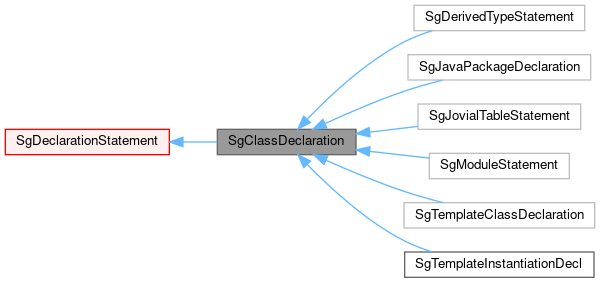
There are no uses of this IR node anywhere. All statements are derived from this SgClassDeclaration class.
This is a base class for all statements.
- See also
- Example of using a SgClassDeclaration object
Definition at line 313513 of file Cxx_Grammar.h.
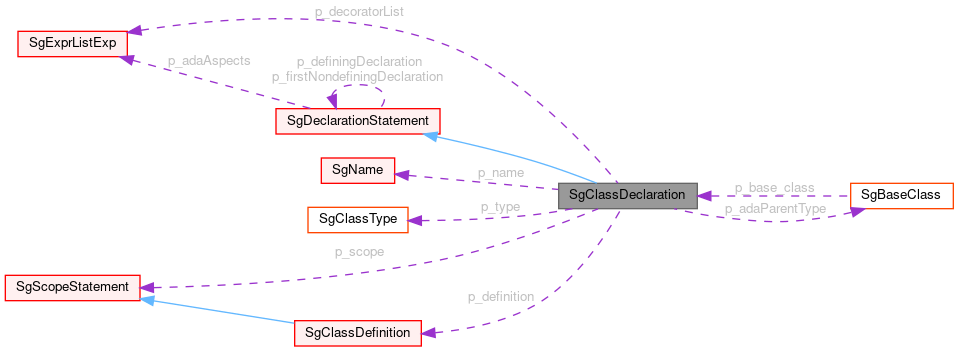
Public Types | |
| enum | class_types { e_class , e_struct , e_union , e_template_parameter , e_fortran_module , e_java_interface , e_java_enum , e_java_parameter , e_jovial_block , e_jovial_table } |
| enum | { static_variant = V_SgClassDeclaration } |
| static variant value More... | |
| typedef SgDeclarationStatement | base_node_type |
 Public Types inherited from SgDeclarationStatement Public Types inherited from SgDeclarationStatement | |
| enum | template_specialization_enum { e_unknown = 0 , e_no_specialization = 1 , e_partial_specialization = 2 , e_specialization = 3 , e_template_specialization_last = 4 } |
| Template Specialization Support. More... | |
| enum | gnu_extension_visability_attribute_enum { e_gnu_attribute_visability_unknown = 0 , e_gnu_attribute_visability_unspecified = 1 , e_gnu_attribute_visability_hidden = 2 , e_gnu_attribute_visability_protected = 3 , e_gnu_attribute_visability_internal = 4 , e_last_gnu_visability_attribute } |
| GNU extension for visibility modifier (only one value can be specified) More... | |
| enum | { static_variant = V_SgDeclarationStatement } |
| static variant value More... | |
| typedef SgStatement | base_node_type |
| Public Types inherited from SgStatement | |
| enum | { static_variant = V_SgStatement } |
| static variant value More... | |
| typedef SgLocatedNode | base_node_type |
| Public Types inherited from SgLocatedNode | |
| enum | { static_variant = V_SgLocatedNode } |
| static variant value More... | |
| typedef SgNode | base_node_type |
| Public Types inherited from SgNode | |
| enum | { static_variant = V_SgNode } |
| static variant value More... | |
| enum | { static_variant = V_SgNode } |
| static variant value More... | |
Public Member Functions | |
| virtual SgNode * | copy (SgCopyHelp &help) const override |
| virtual SgName | get_qualified_name () const |
| virtual SgName | get_mangled_name (void) const override |
| SgName | get_mangled_qualified_name (int &cnt) |
| virtual bool | hasExplicitScope () const override |
| Support for where the scope is explicitly required. | |
| virtual unsigned int | cfgIndexForEnd () const override |
| Determine the CFG index for the end of this construct. | |
| virtual std::vector< VirtualCFG::CFGEdge > | cfgOutEdges (unsigned int index) override |
| Find the out edges of a CFG node – internal version. | |
| virtual std::vector< VirtualCFG::CFGEdge > | cfgInEdges (unsigned int index) override |
| Find the in edges of a CFG node – internal version. | |
| virtual SgSymbol * | get_symbol_from_symbol_table () const override |
| FOR INTERNAL USE Get the associated symbol from the symbol table in the stored scope. Users should use the SgDeclarationStatement::search_for_symbol_from_symbol_table() instead. | |
| virtual void | fixupCopy_scopes (SgNode *copy, SgCopyHelp &help) const override |
| virtual void | fixupCopy_symbols (SgNode *copy, SgCopyHelp &help) const override |
| virtual void | fixupCopy_references (SgNode *copy, SgCopyHelp &help) const override |
| int | get_name_qualification_length () const |
| void | set_name_qualification_length (int name_qualification_length) |
| bool | get_type_elaboration_required () const |
| void | set_type_elaboration_required (bool type_elaboration_required) |
| bool | get_global_qualification_required () const |
| void | set_global_qualification_required (bool global_qualification_required) |
| bool | isSpecialization () const |
| bool | isPartialSpecialization () const |
| virtual std::string | class_name () const override |
| returns a string representing the class name | |
| virtual VariantT | variantT () const override |
| returns new style SageIII enum values | |
| void * | operator new (size_t size) |
| returns pointer to newly allocated IR node | |
| void | operator delete (void *pointer, size_t size) |
| deallocated memory for IR node (returns memory to memory pool for reuse) | |
| void | operator delete (void *pointer) |
| virtual std::vector< SgNode * > | get_traversalSuccessorContainer () const override |
| container of pointers to AST successor nodes used in the traversal overridden in every class by generated implementation | |
| virtual std::vector< std::string > | get_traversalSuccessorNamesContainer () const override |
| container of names of variables or container indices used used in the traversal to access AST successor nodes overridden in every class by generated implementation | |
| virtual size_t | get_numberOfTraversalSuccessors () const override |
| return number of children in the traversal successor list | |
| virtual SgNode * | get_traversalSuccessorByIndex (size_t idx) const override |
| index-based access to traversal successors by index number | |
| virtual size_t | get_childIndex (SgNode *child) const override |
| index-based access to traversal successors by child node | |
| virtual RTIReturnType | roseRTI () override |
| return C++ Runtime-Time-Information | |
| virtual const char * | sage_class_name () const override |
| void | executeVisitorMemberFunction (ROSE_VisitorPattern &visitor) |
| FOR INTERNAL USE Support for visitor pattern. | |
| virtual void | accept (ROSE_VisitorPattern &visitor) override |
| support for the classic visitor pattern done in GoF | |
| virtual bool | isInMemoryPool () override |
| FOR INTERNAL USE This is used in internal tests to verify that all IR nodes are allocated from the heap. | |
| virtual void | checkDataMemberPointersIfInMemoryPool () override |
| FOR INTERNAL USE This is used in internal tests to verify that all IR nodes are allocated from the heap. | |
| virtual std::vector< std::pair< SgNode *, std::string > > | returnDataMemberPointers () const override |
| FOR INTERNAL USE Returns STL vector of pairs of SgNode* and strings for use in AST tools | |
| virtual void | processDataMemberReferenceToPointers (ReferenceToPointerHandler *) override |
| FOR INTERNAL USE Processes pairs of references to SgNode* and strings for use in AST tools | |
| virtual long | getChildIndex (SgNode *childNode) const override |
| FOR INTERNAL USE Returns a unique index value for the childNode in the list of children at this IR node. | |
| SgClassDeclaration (const SgClassDeclarationStorageClass &source) | |
| IR node constructor to support AST File I/O. | |
| SgClassDeclaration * | addRegExpAttribute (std::string s, AstRegExAttribute *a) |
| Support for AST matching using regular expression. | |
| void | post_construction_initialization () override |
| Final initialization for constructors This function is called at the end of generated constructors to allow the specification writer to add special initialization functions or tests. Default is to do nothing. Otherwise it should be overridden in the spec file, in NewHeaderCode/NewOutlinedCode. | |
| SgName | get_name () const |
| void | set_name (SgName name) |
| SgClassDeclaration::class_types | get_class_type () const |
| void | set_class_type (SgClassDeclaration::class_types class_type) |
| SgClassType * | get_type () const |
| void | set_type (SgClassType *type) |
| SgClassDefinition * | get_definition () const |
| void | set_definition (SgClassDefinition *definition) |
| SgScopeStatement * | get_scope () const override |
| Returns scope of current statement. | |
| void | set_scope (SgScopeStatement *scope) override |
| Support for setting scopes (only meaningful on IR statements that store the scope explicitly). | |
| SgDeclarationStatement::template_specialization_enum | get_specialization () const |
| void | set_specialization (SgDeclarationStatement::template_specialization_enum specialization) |
| bool | get_from_template () const |
| void | set_from_template (bool from_template) |
| bool | get_fixupScope () const |
| void | set_fixupScope (bool fixupScope) |
| bool | get_isUnNamed () const |
| void | set_isUnNamed (bool isUnNamed) |
| bool | get_explicit_annotation_interface () const |
| void | set_explicit_annotation_interface (bool explicit_annotation_interface) |
| bool | get_explicit_interface () const |
| void | set_explicit_interface (bool explicit_interface) |
| bool | get_explicit_enum () const |
| void | set_explicit_enum (bool explicit_enum) |
| bool | get_explicit_anonymous () const |
| void | set_explicit_anonymous (bool explicit_anonymous) |
| SgExprListExp * | get_decoratorList () const |
| void | set_decoratorList (SgExprListExp *decoratorList) |
| bool | get_isAutonomousDeclaration () const |
| void | set_isAutonomousDeclaration (bool isAutonomousDeclaration) |
| bool | get_isRepresentingTemplateParameterInTemplateDeclaration () const |
| void | set_isRepresentingTemplateParameterInTemplateDeclaration (bool isRepresentingTemplateParameterInTemplateDeclaration) |
| SgBaseClass * | get_adaParentType () const |
| void | set_adaParentType (SgBaseClass *adaParentType) |
| virtual | ~SgClassDeclaration () |
| This is the destructor. | |
| SgClassDeclaration (Sg_File_Info *startOfConstruct, SgName name="", SgClassDeclaration::class_types class_type=SgClassDeclaration::e_class, SgClassType *type=NULL, SgClassDefinition *definition=NULL) | |
| SgClassDeclaration (SgName name, SgClassDeclaration::class_types class_type, SgClassType *type, SgClassDefinition *definition) | |
| Public Member Functions inherited from SgDeclarationStatement | |
| bool | isForward () const |
| Returns boolean value indicating if this is a forward declaration. | |
| void | setForward () |
| Marks a declaration as a forward declaration. | |
| void | unsetForward () |
| Marks a forward declaration as a non-forward declaration. | |
| bool | isNameOnly () const |
| void | setNameOnly () |
| void | unsetNameOnly () |
| bool | isExternBrace () const |
| void | setExternBrace () |
| void | unsetExternBrace () |
| bool | skipElaborateType () const |
| void | setSkipElaborateType () |
| void | unsetSkipElaborateType () |
| SgQualifiedNamePtrList & | get_qualifiedNameList () |
| const SgQualifiedNamePtrList & | get_qualifiedNameList () const |
| void | set_qualifiedNameList (const SgQualifiedNamePtrList &x) |
| SgDeclarationStatement * | get_declaration_associated_with_symbol () const |
| SgSymbol * | search_for_symbol_from_symbol_table () const |
| User interface for retrieving the associated symbol from the declaration. | |
| bool | hasAssociatedSymbol () const |
| Returns boolean value true of this type of declaration has an associated sysmbol. | |
| SgName | get_qualified_name_prefix () const |
| This function generates the qualified name prefix to be used with the named declaration (only applied to restricted set of declarations where name qualification can be used). | |
| SgName | get_template_name () const |
| This function returns the template name (taken from the template declaration for the class, function, member function, or variable template declaration). | |
| SgDeclarationStatement * | get_definingDeclaration () const |
| This is an access function for the SgDeclarationStatement::p_definingDeclaration data member (see that variable's documentation for details). | |
| void | set_definingDeclaration (SgDeclarationStatement *definingDeclaration) |
| This is an access function for the SgDeclarationStatement::p_definingDeclaration data member (see that variable's documentation for details). | |
| SgDeclarationStatement * | get_firstNondefiningDeclaration () const |
| This is an access function for the SgDeclarationStatement::p_firstNondefiningDeclaration data member (see that variable's documentation for details). | |
| void | set_firstNondefiningDeclaration (SgDeclarationStatement *firstNondefiningDeclaration) |
| This is an access function for the SgDeclarationStatement::p_firstNondefiningDeclaration data member (see that variable's documentation for details). | |
| SgType * | get_type () const |
| std::string | unparseNameToString () |
| void * | operator new (size_t size) |
| returns pointer to newly allocated IR node | |
| void | operator delete (void *pointer, size_t size) |
| deallocated memory for IR node (returns memory to memory pool for reuse) | |
| void | operator delete (void *pointer) |
| void | executeVisitorMemberFunction (ROSE_VisitorPattern &visitor) |
| FOR INTERNAL USE Support for visitor pattern. | |
| SgDeclarationStatement (const SgDeclarationStatementStorageClass &source) | |
| IR node constructor to support AST File I/O. | |
| SgDeclarationStatement * | addRegExpAttribute (std::string s, AstRegExAttribute *a) |
| Support for AST matching using regular expression. | |
| void | post_construction_initialization () override |
| Final initialization for constructors This function is called at the end of generated constructors to allow the specification writer to add special initialization functions or tests. Default is to do nothing. Otherwise it should be overridden in the spec file, in NewHeaderCode/NewOutlinedCode. | |
| unsigned int | get_decl_attributes () const |
| void | set_decl_attributes (unsigned int decl_attributes) |
| std::string | get_linkage () const |
| void | set_linkage (std::string linkage) |
| const SgDeclarationModifier & | get_declarationModifier () const |
| SgDeclarationModifier & | get_declarationModifier () |
| Returns SgDeclarationModifier object by reference (so that it can be set). | |
| bool | get_nameOnly () const |
| void | set_nameOnly (bool nameOnly) |
| bool | get_forward () const |
| void | set_forward (bool forward) |
| bool | get_externBrace () const |
| void | set_externBrace (bool externBrace) |
| bool | get_skipElaborateType () const |
| void | set_skipElaborateType (bool skipElaborateType) |
| std::string | get_binding_label () const |
| void | set_binding_label (std::string binding_label) |
| SgDeclarationScope * | get_declarationScope () const |
| void | set_declarationScope (SgDeclarationScope *declarationScope) |
| bool | get_unparse_template_ast () const |
| void | set_unparse_template_ast (bool unparse_template_ast) |
| SgExprListExp * | get_adaAspects () const |
| void | set_adaAspects (SgExprListExp *adaAspects) |
| virtual | ~SgDeclarationStatement () |
| This is the destructor. | |
| SgDeclarationStatement (Sg_File_Info *startOfConstruct) | |
| This is the constructor. | |
| Public Member Functions inherited from SgStatement | |
| virtual void | setExtern () |
| This function sets "extern" status for the current statement. | |
| virtual void | setStatic () |
| This function sets "static" status for the current statement. | |
| void | insert_statement (SgStatement *target, SgStatement *newstmt, bool inFront=true) |
| This function inserts a single statement at the position indicated by target. | |
| void | insert_statement (SgStatement *target, const SgStatementPtrList &newstmtList, bool inFront=true) |
| This function inserts a list of statements at the position indicated by target. | |
| void | replace_statement (SgStatement *target, SgStatement *newstmt) |
| This function replaces the target statement with a single statement. | |
| void | replace_statement (SgStatement *target, const SgStatementPtrList &newstmtList) |
| This function replaces the target statement with a list of statements. | |
| void | remove_statement (SgStatement *) |
| This function removes the target statement from the AST. | |
| void | insert_statement_from_basicBlock (SgStatement *target, SgStatement *newstmt, bool inFront=true) |
| This function inserts a statement at the position indicated by target. If newstmt is a basicBlock, statements inside newstmt are extracted and then inserted. | |
| void | replace_statement_from_basicBlock (SgStatement *target, SgStatement *newstmt) |
| This function replaces the target statement with a new statement. If newstmt is a basicBlock, statements inside newstmt are extracted and then inserted. | |
| virtual int | replace_expression (SgExpression *original_expression, SgExpression *new_expression) |
| support general replace functions, used in statements that directly contain SgExpression IR nodes. | |
| virtual bool | cfgIsIndexInteresting (unsigned int index) const override |
| Determine whether a particular CFG node index is "interesting" for this kind of node. | |
| virtual unsigned int | cfgFindChildIndex (SgNode *n) override |
| Find the index of n in this node's CFG children. | |
| virtual unsigned int | cfgFindNextChildIndex (SgNode *n) override |
| Find the index just after n in this node's CFG children. | |
| virtual bool | isChildUsedAsLValue (const SgExpression *child) const |
| Virtual function to determine if the provided expression is used as an l-value within the cotext of this statement. | |
| virtual void | set_end_numeric_label (SgLabelRefExp *end_numeric_label) |
| virtual bool | has_end_numeric_label () const |
| bool | hasExplicitType () |
| Some statement store internal SgType pointers explicitly. This function is true if it has a data member that is a type (only applies to SgTypedefDeclaration). | |
| void | post_construction_initialization () override |
| Final initialization for constructors This function is called at the end of generated constructors to allow the specification writer to add special initialization functions or tests. Default is to do nothing. Otherwise it should be overridden in the spec file, in NewHeaderCode/NewOutlinedCode. | |
| void * | operator new (size_t size) |
| returns pointer to newly allocated IR node | |
| void | operator delete (void *pointer, size_t size) |
| deallocated memory for IR node (returns memory to memory pool for reuse) | |
| void | operator delete (void *pointer) |
| void | executeVisitorMemberFunction (ROSE_VisitorPattern &visitor) |
| FOR INTERNAL USE Support for visitor pattern. | |
| SgStatement (const SgStatementStorageClass &source) | |
| IR node constructor to support AST File I/O. | |
| SgStatement * | addRegExpAttribute (std::string s, AstRegExAttribute *a) |
| Support for AST matching using regular expression. | |
| SgLabelRefExp * | get_numeric_label () const |
| void | set_numeric_label (SgLabelRefExp *numeric_label) |
| int | get_source_sequence_value () const |
| void | set_source_sequence_value (int source_sequence_value) |
| virtual | ~SgStatement () |
| This is the destructor. | |
| SgStatement (Sg_File_Info *startOfConstruct) | |
| This is the constructor. | |
| Public Member Functions inherited from SgLocatedNode | |
| const std::string & | getFilenameString () const |
| void | addToAttachedPreprocessingInfo (PreprocessingInfo *prepInfoPtr, PreprocessingInfo::RelativePositionType locationInList=PreprocessingInfo::after) |
| This function adds comment or CPP directives to the current IR node. | |
| void | insertToAttachedPreprocessingInfo (PreprocessingInfo *prepInfoPtr, PreprocessingInfo *anchorInfoPtr, bool insertAfter=true) |
| Insert prepInfo After (or before if last parameter is false) an anchor info ptr in the list of preprocessing info attached to the current node. This is useful to insert things in the middle. | |
| virtual Sg_File_Info * | get_file_info () const override |
| Interface function to implement original SAGE interface to SgFile_Info objects. | |
| virtual void | set_file_info (Sg_File_Info *X) |
| Access function calls set_startingConstruct(Sg_File_Info*) member function. | |
| void | setCompilerGenerated () |
| Allow IR nodes (mostly SgLocatedNode) to be marked as compiler generated. | |
| void | unsetCompilerGenerated () |
| bool | isCompilerGenerated () const |
| Simple test for if this is a compiler generated node. | |
| void | setTransformation () |
| Allow IR nodes (mostly SgLocatedNode) to be marked as a transformation. | |
| void | unsetTransformation () |
| bool | isTransformation () const |
| Simple test for if this is a part of a transformation. | |
| void | setFrontendSpecific () |
| Allow IR nodes (mostly SgLocatedNode) to be marked as front-end specific (generated by the front-end to support a specific backend compiler; e.g. GNU gcc and g++). | |
| void | unsetFrontendSpecific () |
| bool | isFrontendSpecific () const |
| Simple test for if this is a frontend specific IR node. | |
| void | setShared () |
| Allow IR nodes (mostly SgLocatedNode) to be marked as shared. | |
| void | unsetShared () |
| bool | isShared () const |
| Simple test for if this is a shared IR node. | |
| void | setSourcePositionUnavailableInFrontend () |
| Allow IR nodes (mostly SgLocatedNode) to be marked as to when the information was unavilable in the front-end (even if it typically is there are special cases). | |
| void | unsetSourcePositionUnavailableInFrontend () |
| void | setOutputInCodeGeneration () |
| Allow IR nodes (mostly SgLocatedNode) to be marked as to when the information was unavilable in the front-end (even if it typically is there are special cases). | |
| void | unsetOutputInCodeGeneration () |
| bool | isOutputInCodeGeneration () const |
| int | get_physical_file_id () |
| Allow IR nodes (mostly SgLocatedNode) to be queried for there physical file ID. | |
| AttachedPreprocessingInfoType *& | getAttachedPreprocessingInfo (void) |
| Computes the number of nodes in the defined subtree of the AST. | |
| Sg_File_Info * | generateMatchingFileInfo () |
| virtual void | addNewAttribute (std::string s, AstAttribute *a) override |
| Add a new attribute represented by the named string. | |
| virtual AstAttribute * | getAttribute (std::string s) const override |
| Returns attribute of name 's'. | |
| virtual void | updateAttribute (std::string s, AstAttribute *a) override |
| Replace existing attribute of name 's' with new AstAttribute. | |
| virtual void | setAttribute (std::string s, AstAttribute *a) override |
| This is a wrapper function with the following semantics: if no attribute of name 's' exists then addNewAttribute(s,a); is called, otherwise updateAttribute(s,a); is called. | |
| virtual void | removeAttribute (std::string s) override |
| Remove attribute of name 's' if present. | |
| virtual bool | attributeExists (std::string s) const override |
| Tests if attribute of name 's' is present. | |
| virtual int | numberOfAttributes () const override |
| Returns the number of attributes on this IR node. | |
| void * | operator new (size_t size) |
| returns pointer to newly allocated IR node | |
| void | operator delete (void *pointer, size_t size) |
| deallocated memory for IR node (returns memory to memory pool for reuse) | |
| void | operator delete (void *pointer) |
| void | executeVisitorMemberFunction (ROSE_VisitorPattern &visitor) |
| FOR INTERNAL USE Support for visitor pattern. | |
| SgLocatedNode (const SgLocatedNodeStorageClass &source) | |
| IR node constructor to support AST File I/O. | |
| SgLocatedNode * | addRegExpAttribute (std::string s, AstRegExAttribute *a) |
| Support for AST matching using regular expression. | |
| Sg_File_Info * | get_startOfConstruct () const override |
| New function interface for Sg_File_Info data stores starting location of contruct (typically the opening brace or first letter of keyword). | |
| void | set_startOfConstruct (Sg_File_Info *startOfConstruct) |
| This function sets the current source location position of the start of the current construct. | |
| Sg_File_Info * | get_endOfConstruct () const override |
| New function interface for Sg_File_Info data stores ending location of contruct (typically the closing brace). | |
| void | set_endOfConstruct (Sg_File_Info *endOfConstruct) |
| This function sets the current source location position of the end of the current construct. | |
| AttachedPreprocessingInfoType * | get_attachedPreprocessingInfoPtr () const |
| void | set_attachedPreprocessingInfoPtr (AttachedPreprocessingInfoType *attachedPreprocessingInfoPtr) |
| AstAttributeMechanism * | get_attributeMechanism () const override |
| FOR INTERNAL USE Access function; if an attribute exists then a pointer to it is returned, else error. | |
| void | set_attributeMechanism (AstAttributeMechanism *attributeMechanism) override |
| FOR INTERNAL USE Access function; sets poiner to value AstAttributeMechanism. | |
| bool | get_containsTransformationToSurroundingWhitespace () const |
| void | set_containsTransformationToSurroundingWhitespace (bool containsTransformationToSurroundingWhitespace) |
| virtual | ~SgLocatedNode () |
| This is the destructor. | |
| SgLocatedNode (Sg_File_Info *startOfConstruct=NULL) | |
| This is the constructor. | |
| Public Member Functions inherited from SgNode | |
| void * | operator new (size_t size) |
| returns pointer to newly allocated IR node | |
| void | operator delete (void *pointer, size_t size) |
| deallocated memory for IR node (returns memory to memory pool for reuse) | |
| void | operator delete (void *pointer) |
| void | executeVisitorMemberFunction (ROSE_VisitorPattern &visitor) |
| FOR INTERNAL USE Support for visitor pattern. | |
| SgNode (const SgNodeStorageClass &source) | |
| IR node constructor to support AST File I/O. | |
| SgNode * | addRegExpAttribute (std::string s, AstRegExAttribute *a) |
| Support for AST matching using regular expression. | |
| void | set_isModified (bool isModified) |
| All nodes in the AST contain a isModified flag used to track changes to the AST. | |
| void | set_containsTransformation (bool containsTransformation) |
| Many nodes can hide other AST nodes and we need to track when outer nodes contain modified nodes even if they are not themselves modified. | |
| bool | get_isModified () const |
| Acess function for isModified flag. | |
| bool | get_containsTransformation () const |
| Acess function for containsTransformation flag. | |
| SgNode * | get_raw_parent () const |
| Access function for direct access to uncomputed value of parent node. | |
| bool | isChild (SgNode *node) const |
| Query function for if the input IR nodes is a child of the current IR node. | |
| virtual std::string | unparseToString (SgUnparse_Info *info) const |
| This function unparses the AST node (excluding comments and unnecessary white space) | |
| std::string | unparseToString () const |
| int | variant () const |
| Older version function returns enum value "NODE". | |
| VirtualCFG::CFGNode | cfgForBeginning () |
| Returns the CFG node for just before this AST node. | |
| VirtualCFG::CFGNode | cfgForEnd () |
| Returns the CFG node for just after this AST node. | |
| int | numberOfNodesInSubtree () |
| Computes the number of nodes in the defined subtree of the AST. | |
| int | depthOfSubtree () |
| Computes the depth of the current defined subtree of the AST. | |
| template<class T > | |
| T * | initParentPointer (T *child, SgNode *parent) |
| Generated for tree edge data member initializations. | |
| SgNode * | get_freepointer () const |
| void | set_freepointer (SgNode *freepointer) |
| virtual | ~SgNode () |
| This is the destructor. | |
| SgNode () | |
| This is the constructor. | |
| void * | operator new (size_t size) |
| returns pointer to newly allocated IR node | |
| void | operator delete (void *pointer, size_t size) |
| deallocated memory for IR node (returns memory to memory pool for reuse) | |
| void | operator delete (void *pointer) |
| void | executeVisitorMemberFunction (ROSE_VisitorPattern &visitor) |
| FOR INTERNAL USE Support for visitor pattern. | |
| SgNode (const SgNodeStorageClass &source) | |
| IR node constructor to support AST File I/O. | |
| SgNode * | addRegExpAttribute (std::string s, AstRegExAttribute *a) |
| Support for AST matching using regular expression. | |
| void | set_isModified (bool isModified) |
| All nodes in the AST contain a isModified flag used to track changes to the AST. | |
| void | set_containsTransformation (bool containsTransformation) |
| Many nodes can hide other AST nodes and we need to track when outer nodes contain modified nodes even if they are not themselves modified. | |
| bool | get_isModified () const |
| Acess function for isModified flag. | |
| bool | get_containsTransformation () const |
| Acess function for containsTransformation flag. | |
| void | set_parent (SgNode *parent) |
| All nodes in the AST contain a reference to a parent node. | |
| SgNode * | get_parent () const |
| Access function for parent node. | |
| SgNode * | get_raw_parent () const |
| Access function for direct access to uncomputed value of parent node. | |
| bool | isChild (SgNode *node) const |
| Query function for if the input IR nodes is a child of the current IR node. | |
| virtual std::string | unparseToString (SgUnparse_Info *info) const |
| This function unparses the AST node (excluding comments and unnecessary white space) | |
| std::string | unparseToString () const |
| std::string | unparseToCompleteString () |
| This function unparses the AST node (including comments and white space) | |
| int | variant () const |
| bool | get_isVisited () const |
| DOCS IN HEADER: Access function for p_isVisited flag used previously by the AST traversals. | |
| void | set_isVisited (bool isVisited) |
| Access function for p_isVisited flag used previously by the AST traversals. | |
| VirtualCFG::CFGNode | cfgForBeginning () |
| Returns the CFG node for just before this AST node. | |
| VirtualCFG::CFGNode | cfgForEnd () |
| Returns the CFG node for just after this AST node. | |
| int | numberOfNodesInSubtree () |
| Computes the number of nodes in the defined subtree of the AST. | |
| int | depthOfSubtree () |
| Computes the depth of the current defined subtree of the AST. | |
| template<class T > | |
| T * | initParentPointer (T *child, SgNode *parent) |
| Generated for tree edge data member initializations. | |
| SgNode * | get_freepointer () const |
| void | set_freepointer (SgNode *freepointer) |
| void | set_parent (SgNode *parent) |
| All nodes in the AST contain a reference to a parent node. | |
| SgNode * | get_parent () const |
| Access function for parent node. | |
| std::string | unparseToCompleteString () |
| This function unparses the AST node (including comments and white space) | |
| bool | get_isVisited () const |
| DOCS IN HEADER: Access function for p_isVisited flag used previously by the AST traversals. | |
| void | set_isVisited (bool isVisited) |
| Access function for p_isVisited flag used previously by the AST traversals. | |
| template<class T > | |
| std::enable_if< std::is_pointer< T >::value, void >::type | changeChildPointer (T &edge, T const &child) |
| Set a child edge in a tree to point to a specific child. | |
| template<class T > | |
| std::enable_if<!std::is_pointer< T >::value, void >::type | changeChildPointer (T &edge, T const &child) |
| Set a child edge in a tree to point to a specific child. | |
| template<class T > | |
| std::enable_if< std::is_pointer< T >::value, void >::type | changeChildPointer (T &edge, T const &child) |
| Set a child edge in a tree to point to a specific child. | |
| template<class T > | |
| std::enable_if<!std::is_pointer< T >::value, void >::type | changeChildPointer (T &edge, T const &child) |
| Set a child edge in a tree to point to a specific child. | |
Static Public Member Functions | |
| static void | deleteMemoryPool () |
| static size_t | numberOfNodes () |
| Returns the total number of IR nodes of this type. | |
| static size_t | memoryUsage () |
| Returns the size in bytes of the total memory allocated for all IR nodes of this type. | |
| static void | traverseMemoryPoolNodes (ROSE_VisitTraversal &visit) |
| FOR INTERNAL USE Support for visitor pattern over all IR nodes by type of IR node. | |
| static void | traverseMemoryPoolVisitorPattern (ROSE_VisitorPattern &visitor) |
| FOR INTERNAL USE Support for visitor pattern. | |
| static void | visitRepresentativeNode (ROSE_VisitTraversal &visit) |
| FOR INTERNAL USE Support for type-based traversal. | |
| static SgNode * | getNodeByNodeId (VariantT variantT, size_t poolIdx, size_t itemIdx) |
| Find a node by its variant type, pool index, and item index. | |
| static SgClassDeclaration * | getNodeByNodeIdInternal (size_t poolIdx, size_t itemIdx) |
| FOR INTERNAL USE Find an SgNode from its memory pool and location therin. | |
| static std::string | getNodeIdString (SgClassDeclaration *sgnode) |
| compute the NodeId for a particular SgNode*. | |
| static std::string | getNodeIdStringInternal (SgClassDeclaration *sgnode) |
| Static Public Member Functions inherited from SgDeclarationStatement | |
| static void | deleteMemoryPool () |
| static size_t | numberOfNodes () |
| Returns the total number of IR nodes of this type. | |
| static size_t | memoryUsage () |
| Returns the size in bytes of the total memory allocated for all IR nodes of this type. | |
| static void | traverseMemoryPoolNodes (ROSE_VisitTraversal &visit) |
| FOR INTERNAL USE Support for visitor pattern over all IR nodes by type of IR node. | |
| static void | traverseMemoryPoolVisitorPattern (ROSE_VisitorPattern &visitor) |
| FOR INTERNAL USE Support for visitor pattern. | |
| static void | visitRepresentativeNode (ROSE_VisitTraversal &visit) |
| FOR INTERNAL USE Support for type-based traversal. | |
| static SgNode * | getNodeByNodeId (VariantT variantT, size_t poolIdx, size_t itemIdx) |
| Find a node by its variant type, pool index, and item index. | |
| static SgDeclarationStatement * | getNodeByNodeIdInternal (size_t poolIdx, size_t itemIdx) |
| FOR INTERNAL USE Find an SgNode from its memory pool and location therin. | |
| static std::string | getNodeIdString (SgDeclarationStatement *sgnode) |
| compute the NodeId for a particular SgNode*. | |
| static std::string | getNodeIdStringInternal (SgDeclarationStatement *sgnode) |
| Static Public Member Functions inherited from SgStatement | |
| static void | deleteMemoryPool () |
| static size_t | numberOfNodes () |
| Returns the total number of IR nodes of this type. | |
| static size_t | memoryUsage () |
| Returns the size in bytes of the total memory allocated for all IR nodes of this type. | |
| static void | traverseMemoryPoolNodes (ROSE_VisitTraversal &visit) |
| FOR INTERNAL USE Support for visitor pattern over all IR nodes by type of IR node. | |
| static void | traverseMemoryPoolVisitorPattern (ROSE_VisitorPattern &visitor) |
| FOR INTERNAL USE Support for visitor pattern. | |
| static void | visitRepresentativeNode (ROSE_VisitTraversal &visit) |
| FOR INTERNAL USE Support for type-based traversal. | |
| static SgNode * | getNodeByNodeId (VariantT variantT, size_t poolIdx, size_t itemIdx) |
| Find a node by its variant type, pool index, and item index. | |
| static SgStatement * | getNodeByNodeIdInternal (size_t poolIdx, size_t itemIdx) |
| FOR INTERNAL USE Find an SgNode from its memory pool and location therin. | |
| static std::string | getNodeIdString (SgStatement *sgnode) |
| compute the NodeId for a particular SgNode*. | |
| static std::string | getNodeIdStringInternal (SgStatement *sgnode) |
| Static Public Member Functions inherited from SgLocatedNode | |
| static void | deleteMemoryPool () |
| static size_t | numberOfNodes () |
| Returns the total number of IR nodes of this type. | |
| static size_t | memoryUsage () |
| Returns the size in bytes of the total memory allocated for all IR nodes of this type. | |
| static void | traverseMemoryPoolNodes (ROSE_VisitTraversal &visit) |
| FOR INTERNAL USE Support for visitor pattern over all IR nodes by type of IR node. | |
| static void | traverseMemoryPoolVisitorPattern (ROSE_VisitorPattern &visitor) |
| FOR INTERNAL USE Support for visitor pattern. | |
| static void | visitRepresentativeNode (ROSE_VisitTraversal &visit) |
| FOR INTERNAL USE Support for type-based traversal. | |
| static SgNode * | getNodeByNodeId (VariantT variantT, size_t poolIdx, size_t itemIdx) |
| Find a node by its variant type, pool index, and item index. | |
| static SgLocatedNode * | getNodeByNodeIdInternal (size_t poolIdx, size_t itemIdx) |
| FOR INTERNAL USE Find an SgNode from its memory pool and location therin. | |
| static std::string | getNodeIdString (SgLocatedNode *sgnode) |
| compute the NodeId for a particular SgNode*. | |
| static std::string | getNodeIdStringInternal (SgLocatedNode *sgnode) |
| Static Public Member Functions inherited from SgNode | |
| static void | deleteMemoryPool () |
| static size_t | numberOfNodes () |
| Returns the total number of IR nodes of this type. | |
| static size_t | memoryUsage () |
| Returns the size in bytes of the total memory allocated for all IR nodes of this type. | |
| static void | traverseMemoryPoolNodes (ROSE_VisitTraversal &visit) |
| FOR INTERNAL USE Support for visitor pattern over all IR nodes by type of IR node. | |
| static void | traverseMemoryPoolVisitorPattern (ROSE_VisitorPattern &visitor) |
| FOR INTERNAL USE Support for visitor pattern. | |
| static void | visitRepresentativeNode (ROSE_VisitTraversal &visit) |
| FOR INTERNAL USE Support for type-based traversal. | |
| static SgNode * | getNodeByNodeId (VariantT variantT, size_t poolIdx, size_t itemIdx) |
| Find a node by its variant type, pool index, and item index. | |
| static SgNode * | getNodeByNodeIdInternal (size_t poolIdx, size_t itemIdx) |
| FOR INTERNAL USE Find an SgNode from its memory pool and location therin. | |
| static std::string | getNodeIdString (SgNode *sgnode) |
| compute the NodeId for a particular SgNode*. | |
| static std::string | getNodeIdStringInternal (SgNode *sgnode) |
| static std::vector< std::string > | buildCommandLineToSubstituteTransformationFile (const std::vector< std::string > &argv, std::string newFileName) |
| Command line support for this compilation The command line is saved as a static variable so that it will be available to support the rewrite mechanism. | |
| static std::vector< VariantT > | getClassHierarchySubTreeFunction (VariantT v) |
| static void | getClassHierarchySubTreeFunction (VariantT v, std::vector< VariantT > &) |
| static std::map< SgNode *, std::string > & | get_globalMangledNameMap () |
| Access function for performance optimizing global mangled name map. | |
| static void | clearGlobalMangledNameMap () |
| Support to clear the performance optimizing global mangled name map. | |
| static std::map< std::string, uint64_t > & | get_shortMangledNameCache () |
| Access function for lower level optimizing of global mangled name map. | |
| static SgUnorderedMapNodeToString & | get_globalQualifiedNameMapForNames () |
| Access function for name qualification support (for names). | |
| static void | set_globalQualifiedNameMapForNames (const SgUnorderedMapNodeToString &X) |
| Access function for name qualification support (for names). | |
| static SgUnorderedMapNodeToString & | get_globalQualifiedNameMapForTypes () |
| Access function for name qualification support (for type). | |
| static void | set_globalQualifiedNameMapForTypes (const SgUnorderedMapNodeToString &X) |
| Access function for name qualification support (for type). | |
| static std::map< SgNode *, SgUnorderedMapNodeToString > & | get_globalQualifiedNameMapForMapsOfTypes () |
| Access function for name qualification support (for maps of types). | |
| static void | set_globalQualifiedNameMapForMapsOfTypes (const std::map< SgNode *, SgUnorderedMapNodeToString > &X) |
| Access function for name qualification support (for maps of types). | |
| static SgUnorderedMapNodeToString & | get_globalQualifiedNameMapForTemplateHeaders () |
| Access function for name qualification support (for template headers in template declarations). | |
| static void | set_globalQualifiedNameMapForTemplateHeaders (const SgUnorderedMapNodeToString &X) |
| Access function for name qualification support (for template headers in template declarations). | |
| static SgUnorderedMapNodeToString & | get_globalTypeNameMap () |
| Access function for name qualification support (for names of types). | |
| static void | set_globalTypeNameMap (const SgUnorderedMapNodeToString &X) |
| Access function for name qualification support (for names of types). | |
| static SgFunctionTypeTable * | get_globalFunctionTypeTable () |
| Access function for symbol table specific to function types. | |
| static void | set_globalFunctionTypeTable (SgFunctionTypeTable *globalFunctionTypeTable) |
| Access function for symbol table specific to function types. | |
| static SgTypeTable * | get_globalTypeTable () |
| Access function for symbol table specific to non-function types. | |
| static void | set_globalTypeTable (SgTypeTable *globalTypeTable) |
| Access function for symbol table specific to non-function types. | |
| static VariantT | variantFromPool (SgNode const *n) |
| template<class T > | |
| static std::enable_if< std::is_base_of< SgNode, T >::value, T * >::type | createAndParent (SgNode *parent) |
| Allocate and return a new node after setting its parent. | |
| static void | deleteMemoryPool () |
| static size_t | numberOfNodes () |
| Returns the total number of IR nodes of this type. | |
| static size_t | memoryUsage () |
| Returns the size in bytes of the total memory allocated for all IR nodes of this type. | |
| static void | traverseMemoryPoolNodes (ROSE_VisitTraversal &visit) |
| FOR INTERNAL USE Support for visitor pattern over all IR nodes by type of IR node. | |
| static void | traverseMemoryPoolVisitorPattern (ROSE_VisitorPattern &visitor) |
| FOR INTERNAL USE Support for visitor pattern. | |
| static void | visitRepresentativeNode (ROSE_VisitTraversal &visit) |
| FOR INTERNAL USE Support for type-based traversal. | |
| static SgNode * | getNodeByNodeId (VariantT variantT, size_t poolIdx, size_t itemIdx) |
| Find a node by its variant type, pool index, and item index. | |
| static SgNode * | getNodeByNodeIdInternal (size_t poolIdx, size_t itemIdx) |
| FOR INTERNAL USE Find an SgNode from its memory pool and location therin. | |
| static std::string | getNodeIdString (SgNode *sgnode) |
| compute the NodeId for a particular SgNode*. | |
| static std::string | getNodeIdStringInternal (SgNode *sgnode) |
| static std::vector< std::string > | buildCommandLineToSubstituteTransformationFile (const std::vector< std::string > &argv, std::string newFileName) |
| Command line support for this compilation The command line is saved as a static variable so that it will be available to support the rewrite mechanism. | |
| static std::vector< VariantT > | getClassHierarchySubTreeFunction (VariantT v) |
| static void | getClassHierarchySubTreeFunction (VariantT v, std::vector< VariantT > &) |
| static std::map< SgNode *, std::string > & | get_globalMangledNameMap () |
| Access function for performance optimizing global mangled name map. | |
| static void | clearGlobalMangledNameMap () |
| Support to clear the performance optimizing global mangled name map. | |
| static std::map< std::string, uint64_t > & | get_shortMangledNameCache () |
| Access function for lower level optimizing of global mangled name map. | |
| static SgUnorderedMapNodeToString & | get_globalQualifiedNameMapForNames () |
| Access function for name qualification support (for names). | |
| static void | set_globalQualifiedNameMapForNames (const SgUnorderedMapNodeToString &X) |
| Access function for name qualification support (for names). | |
| static SgUnorderedMapNodeToString & | get_globalQualifiedNameMapForTypes () |
| Access function for name qualification support (for type). | |
| static void | set_globalQualifiedNameMapForTypes (const SgUnorderedMapNodeToString &X) |
| Access function for name qualification support (for type). | |
| static std::map< SgNode *, SgUnorderedMapNodeToString > & | get_globalQualifiedNameMapForMapsOfTypes () |
| Access function for name qualification support (for maps of types). | |
| static void | set_globalQualifiedNameMapForMapsOfTypes (const std::map< SgNode *, SgUnorderedMapNodeToString > &X) |
| Access function for name qualification support (for maps of types). | |
| static SgUnorderedMapNodeToString & | get_globalQualifiedNameMapForTemplateHeaders () |
| Access function for name qualification support (for template headers in template declarations). | |
| static void | set_globalQualifiedNameMapForTemplateHeaders (const SgUnorderedMapNodeToString &X) |
| Access function for name qualification support (for template headers in template declarations). | |
| static SgUnorderedMapNodeToString & | get_globalTypeNameMap () |
| Access function for name qualification support (for names of types). | |
| static void | set_globalTypeNameMap (const SgUnorderedMapNodeToString &X) |
| Access function for name qualification support (for names of types). | |
| static SgFunctionTypeTable * | get_globalFunctionTypeTable () |
| Access function for symbol table specific to function types. | |
| static void | set_globalFunctionTypeTable (SgFunctionTypeTable *globalFunctionTypeTable) |
| Access function for symbol table specific to function types. | |
| static SgTypeTable * | get_globalTypeTable () |
| Access function for symbol table specific to non-function types. | |
| static void | set_globalTypeTable (SgTypeTable *globalTypeTable) |
| Access function for symbol table specific to non-function types. | |
| static VariantT | variantFromPool (SgNode const *n) |
| template<class T > | |
| static std::enable_if< std::is_base_of< SgNode, T >::value, T * >::type | createAndParent (SgNode *parent) |
| Allocate and return a new node after setting its parent. | |
Protected Member Functions | |
| virtual bool | replace_child (SgStatement *, SgStatement *, bool extractListFromBasicBlock=false) override |
| Private supporting function for low level SageIII rewrite interface. | |
| SgClassDefinition * | compute_classDefinition () const |
| Protected Member Functions inherited from SgDeclarationStatement | |
| void | resetTemplateNameSupport (bool &nameResetFromMangledForm, SgName &name) |
| void | testForBadGenerateTemplateName (const std::string &name) |
| bool | skipEmptyTemplateArgumentListTest (SgFunctionDeclaration *functionDeclaration) |
| SgName | fixupTemplateNameForMangledNameSupport (const SgName &s) const |
| SgName | generate_alternative_name_for_unnamed_declaration (SgNode *parent) const |
| SgName | generate_alternative_name_for_unnamed_declaration_in_scope (SgScopeStatement *scope) const |
| Protected Member Functions inherited from SgStatement | |
| virtual bool | insert_child (SgStatement *, SgStatement *, bool inFront=true, bool extractListFromBasicBlock=false) |
| Private supporting function for low level SageIII rewrite interface. | |
| Protected Member Functions inherited from SgNode | |
| virtual void | destructorHelper () |
| This gets called by all Rosebud-generated destructors. | |
| virtual void | destructorHelper () |
| This gets called by all Rosebud-generated destructors. | |
| virtual void | debugSerializationBegin (const char *className) |
| Called by generated serializers. | |
| virtual void | debugSerializationEnd (const char *className) |
| Called by generated serializers. | |
| virtual void | debugSerializationBegin (const char *className) |
| Called by generated serializers. | |
| virtual void | debugSerializationEnd (const char *className) |
| Called by generated serializers. | |
Protected Attributes | |
| SgName | p_name |
| This is the name of the class or instantiated class template. | |
| SgClassDeclaration::class_types | p_class_type |
| Enum value classifying this as a class,struct,or union. | |
| SgClassType * | p_type |
| This is the type used in the declaration (SgClassType). | |
| SgClassDefinition * | p_definition |
| This is the class definition (alway a valid pointer, except for explicitly marked forward declarations). | |
| SgScopeStatement * | p_scope |
| SgDeclarationStatement::template_specialization_enum | p_specialization |
| bool | p_from_template |
| This records if the class declaration is associated with a template. | |
| bool | p_fixupScope |
| bool | p_isUnNamed |
| bool | p_explicit_annotation_interface |
| bool | p_explicit_interface |
| bool | p_explicit_enum |
| bool | p_explicit_anonymous |
| SgExprListExp * | p_decoratorList |
| int | p_name_qualification_length |
| bool | p_type_elaboration_required |
| bool | p_global_qualification_required |
| bool | p_isAutonomousDeclaration |
| bool | p_isRepresentingTemplateParameterInTemplateDeclaration |
| SgBaseClass * | p_adaParentType |
| Protected Attributes inherited from SgDeclarationStatement | |
| unsigned int | p_decl_attributes |
| This is old and used to be used to hold modifiers. | |
| std::string | p_linkage |
| This string stores the value "C", "C++", or "fortran" to define the external linkage for generating linkable names. | |
| SgDeclarationModifier | p_declarationModifier |
| This is the mechanism to handle declaration modifiers. | |
| bool | p_nameOnly |
| I think this is somewhat redundant with the purpose of specifying a forward declaration. Either that or it is information used by the unparser (Oh, I hope not!). | |
| bool | p_forward |
| This marks a declaration as being an explicit forward declaration. | |
| bool | p_externBrace |
| This marks that the declaration appeared with "extern". | |
| bool | p_skipElaborateType |
| This marks "type elaboration" which is the use of the keyword "class" before variables of type class. | |
| SgDeclarationStatement * | p_definingDeclaration |
| This pointer is valid only if a defining declaration exists, and stores the defining declaration where the declaration was defined. | |
| SgDeclarationStatement * | p_firstNondefiningDeclaration |
| This pointer is valid if there is a non-defining declaration, and stores the first non-defining declaration where a declaration was made explicitly (as in forward declaration) or implicitly as in the case of a few IR nodes (e.g. SgClassDeclaration). See description of SgDeclarationStatement. | |
| SgQualifiedNamePtrList | p_qualifiedNameList |
| std::string | p_binding_label |
| SgDeclarationScope * | p_declarationScope |
| bool | p_unparse_template_ast |
| SgExprListExp * | p_adaAspects |
| Protected Attributes inherited from SgStatement | |
| SgLabelRefExp * | p_numeric_label |
| int | p_source_sequence_value |
| Protected Attributes inherited from SgLocatedNode | |
| Sg_File_Info * | p_startOfConstruct |
| This pointer is always valid and stores the source position of the start of the current construct. | |
| Sg_File_Info * | p_endOfConstruct |
| This pointer is always valid and stores the source position of the end of the current construct. | |
| AttachedPreprocessingInfoType * | p_attachedPreprocessingInfoPtr |
| Holds comments and/or preprocessor directives located before or after the current statement of expression. | |
| AstAttributeMechanism * | p_attributeMechanism |
| bool | p_containsTransformationToSurroundingWhitespace |
| Protected Attributes inherited from SgNode | |
| SgNode * | p_parent |
| This is the pointer to the parent IR node in the AST. | |
| bool | p_isModified |
| Records if IR node has been modified (data members reset). | |
| bool | p_containsTransformation |
| SgNode * | p_freepointer |
| This is the pointer to the chain of previously freed objects. | |
Additional Inherited Members | |
| Static Protected Attributes inherited from SgNode | |
| static std::vector< std::tuple< unsigned char *, unsigned, VariantT > > | all_pools |
| static SgFunctionTypeTable * | p_globalFunctionTypeTable |
| Pointer to symbol table specific to function types. | |
| static SgTypeTable * | p_globalTypeTable |
| static std::map< SgNode *, std::string > | p_globalMangledNameMap |
| Cache of mangled names to avoid regeneration of previously build mangled names or parts of mangled names. This is a performance optimization. | |
| static std::map< std::string, uint64_t > | p_shortMangledNameCache |
| STL map used as a cache to shorten generated mangled names. This is mostly a space optimization ofr mangled names of templates. | |
| static std::unordered_map< SgNode *, std::string > | p_globalQualifiedNameMapForNames |
| static std::unordered_map< SgNode *, std::string > | p_globalQualifiedNameMapForTypes |
| static std::unordered_map< SgNode *, std::string > | p_globalQualifiedNameMapForTemplateHeaders |
| static std::unordered_map< SgNode *, std::string > | p_globalTypeNameMap |
| static std::map< SgNode *, std::unordered_map< SgNode *, std::string > > | p_globalQualifiedNameMapForMapsOfTypes |
Member Typedef Documentation
◆ base_node_type
Definition at line 314007 of file Cxx_Grammar.h.
Member Enumeration Documentation
◆ class_types
A declaration can be of either class, struct, union, or ...
Definition at line 313526 of file Cxx_Grammar.h.
◆ anonymous enum
| anonymous enum |
static variant value
Definition at line 313628 of file Cxx_Grammar.h.
Constructor & Destructor Documentation
◆ ~SgClassDeclaration()
|
virtual |
This is the destructor.
There are a lot of things to delete, but nothing is deleted in this destructor.
Member Function Documentation
◆ copy()
|
overridevirtual |
Reimplemented from SgDeclarationStatement.
◆ get_mangled_name()
|
overridevirtual |
Reimplemented from SgDeclarationStatement.
◆ get_mangled_qualified_name()
| SgName SgClassDeclaration::get_mangled_qualified_name | ( | int & | cnt | ) |
◆ replace_child()
|
overrideprotectedvirtual |
Private supporting function for low level SageIII rewrite interface.
This function implements special semantics for the insertion of a collection of statements in a block. If extractListFromBasicBlock is true then the statements in the block are extracts and placed into the same scope as the target position.
- Returns
- Returns bool.
Reimplemented from SgStatement.
◆ hasExplicitScope()
|
overridevirtual |
Support for where the scope is explicitly required.
Reimplemented from SgStatement.
◆ cfgIndexForEnd()
|
overridevirtual |
Determine the CFG index for the end of this construct.
Reimplemented from SgStatement.
Reimplemented in SgModuleStatement.
◆ cfgOutEdges()
|
overridevirtual |
Find the out edges of a CFG node – internal version.
Reimplemented from SgStatement.
Reimplemented in SgModuleStatement.
◆ cfgInEdges()
|
overridevirtual |
Find the in edges of a CFG node – internal version.
Reimplemented from SgStatement.
Reimplemented in SgModuleStatement.
◆ get_symbol_from_symbol_table()
|
overridevirtual |
FOR INTERNAL USE Get the associated symbol from the symbol table in the stored scope. Users should use the SgDeclarationStatement::search_for_symbol_from_symbol_table() instead.
Reimplemented from SgDeclarationStatement.
Reimplemented in SgTemplateInstantiationDecl.
Referenced by SageBuilder::buildClassDeclaration_nfi(), SageBuilder::buildNondefiningClassDeclaration_nfi(), SageBuilder::buildNondefiningTemplateClassDeclaration_nfi(), SageBuilder::buildTemplateClassDeclaration_nfi(), SageInterface::deleteAST(), SageInterface::fixStructDeclaration(), and CollectDependentDeclarationsTraversal::visit().
◆ fixupCopy_scopes()
|
overridevirtual |
Reimplemented from SgDeclarationStatement.
◆ fixupCopy_symbols()
|
overridevirtual |
Reimplemented from SgDeclarationStatement.
◆ fixupCopy_references()
|
overridevirtual |
Reimplemented from SgDeclarationStatement.
◆ class_name()
|
overridevirtual |
returns a string representing the class name
Reimplemented from SgDeclarationStatement.
Reimplemented in SgTemplateClassDeclaration, SgTemplateInstantiationDecl, SgDerivedTypeStatement, SgModuleStatement, SgJavaPackageDeclaration, and SgJovialTableStatement.
Referenced by SageInterface::appendStatement(), SageBuilder::buildClassDeclaration_nfi(), SageBuilder::buildNondefiningClassDeclaration(), SageBuilder::buildNondefiningClassDeclaration_nfi(), SageInterface::getClassTypeChainForMemberReference(), SageInterface::getEnclosingFileNode(), and SageInterface::rebuildSymbolTable().
◆ variantT()
|
overridevirtual |
returns new style SageIII enum values
Reimplemented from SgDeclarationStatement.
Reimplemented in SgTemplateClassDeclaration, SgTemplateInstantiationDecl, SgDerivedTypeStatement, SgModuleStatement, SgJavaPackageDeclaration, and SgJovialTableStatement.
Referenced by SageBuilder::buildNondefiningClassDeclaration_nfi().
◆ operator delete()
|
inline |
Definition at line 313683 of file Cxx_Grammar.h.
◆ get_traversalSuccessorContainer()
|
overridevirtual |
container of pointers to AST successor nodes used in the traversal overridden in every class by generated implementation
Reimplemented from SgDeclarationStatement.
Reimplemented in SgTemplateClassDeclaration, SgTemplateInstantiationDecl, SgDerivedTypeStatement, SgModuleStatement, SgJavaPackageDeclaration, and SgJovialTableStatement.
◆ get_traversalSuccessorNamesContainer()
|
overridevirtual |
container of names of variables or container indices used used in the traversal to access AST successor nodes overridden in every class by generated implementation
Reimplemented from SgDeclarationStatement.
Reimplemented in SgTemplateClassDeclaration, SgTemplateInstantiationDecl, SgDerivedTypeStatement, SgModuleStatement, SgJavaPackageDeclaration, and SgJovialTableStatement.
◆ get_numberOfTraversalSuccessors()
|
overridevirtual |
return number of children in the traversal successor list
Reimplemented from SgDeclarationStatement.
Reimplemented in SgTemplateClassDeclaration, SgTemplateInstantiationDecl, SgDerivedTypeStatement, SgModuleStatement, SgJavaPackageDeclaration, and SgJovialTableStatement.
◆ get_traversalSuccessorByIndex()
|
overridevirtual |
index-based access to traversal successors by index number
Reimplemented from SgDeclarationStatement.
Reimplemented in SgTemplateClassDeclaration, SgTemplateInstantiationDecl, SgDerivedTypeStatement, SgModuleStatement, SgJavaPackageDeclaration, and SgJovialTableStatement.
◆ get_childIndex()
|
overridevirtual |
index-based access to traversal successors by child node
Reimplemented from SgDeclarationStatement.
Reimplemented in SgTemplateClassDeclaration, SgTemplateInstantiationDecl, SgDerivedTypeStatement, SgModuleStatement, SgJavaPackageDeclaration, and SgJovialTableStatement.
◆ roseRTI()
|
overridevirtual |
return C++ Runtime-Time-Information
Reimplemented from SgDeclarationStatement.
Reimplemented in SgTemplateClassDeclaration, SgTemplateInstantiationDecl, SgDerivedTypeStatement, SgModuleStatement, SgJavaPackageDeclaration, and SgJovialTableStatement.
◆ sage_class_name()
|
overridevirtual |
returns a C style string (char*) representing the class name
Reimplemented from SgDeclarationStatement.
Reimplemented in SgTemplateClassDeclaration, SgTemplateInstantiationDecl, SgDerivedTypeStatement, SgModuleStatement, SgJavaPackageDeclaration, and SgJovialTableStatement.
◆ accept()
|
overridevirtual |
support for the classic visitor pattern done in GoF
Reimplemented from SgDeclarationStatement.
Reimplemented in SgTemplateClassDeclaration, SgTemplateInstantiationDecl, SgDerivedTypeStatement, SgModuleStatement, SgJavaPackageDeclaration, and SgJovialTableStatement.
◆ isInMemoryPool()
|
overridevirtual |
FOR INTERNAL USE This is used in internal tests to verify that all IR nodes are allocated from the heap.
The AST File I/O depends upon the allocation of IR nodes being from the heap, stack based or global IR nodes should not appear in the AST if it will be written out to a file and read back in. To enforce this concept, this function implements a test to verify that the IR node can be found on the heap and is part of a larger test of the whole AST. This test must pass before the AST can be written out to a file. This is part of a compromise in the design of the AST File I/O to support binary streaming of data to files; for performance. It is also rather difficult, but possible, to build a useful AST with IR nodes allocated on the stack or frm global scope, this test filters out such cased from being used with the AST File I/O mechanism.
Reimplemented from SgDeclarationStatement.
Reimplemented in SgTemplateClassDeclaration, SgTemplateInstantiationDecl, SgDerivedTypeStatement, SgModuleStatement, SgJavaPackageDeclaration, and SgJovialTableStatement.
◆ checkDataMemberPointersIfInMemoryPool()
|
overridevirtual |
FOR INTERNAL USE This is used in internal tests to verify that all IR nodes are allocated from the heap.
The AST File I/O depends upon the allocation of IR nodes being from the heap, stack based or global IR nodes should not appear in the AST if it will be written out to a file and read back in. To enforce this concept, this function implements a test to verify that the IR node can be found on the heap and is part of a larger test of the whole AST. This test must pass before the AST can be written out to a file. This is part of a compromise in the design of the AST File I/O to support binary streaming of data to files; for performance. It is also rather difficult, but possible, to build a useful AST with IR nodes allocated on the stack or frm global scope, this test filters out such cased from being used with the AST File I/O mechanism.
Reimplemented from SgDeclarationStatement.
Reimplemented in SgTemplateClassDeclaration, SgTemplateInstantiationDecl, SgDerivedTypeStatement, SgModuleStatement, SgJavaPackageDeclaration, and SgJovialTableStatement.
◆ returnDataMemberPointers()
|
overridevirtual |
FOR INTERNAL USE Returns STL vector of pairs of SgNode* and strings for use in AST tools
This functions is part of general support for many possible tools to operate on the AST. The forms a list of ALL IR node pointers used by each IR node, and is a supperset of the get_traversalSuccessorContainer(). It is (I think) less than the set of pointers used by the AST file I/O. This is part of work implemented by Andreas, and support tools such as the AST graph generation.
- Warning
- This function can return unexpected data members and thus the order and the number of elements is unpredicable and subject to change.
- Returns
- STL vector of pairs of SgNode* and strings
Reimplemented from SgDeclarationStatement.
Reimplemented in SgTemplateClassDeclaration, SgTemplateInstantiationDecl, SgDerivedTypeStatement, SgModuleStatement, SgJavaPackageDeclaration, and SgJovialTableStatement.
◆ processDataMemberReferenceToPointers()
|
overridevirtual |
FOR INTERNAL USE Processes pairs of references to SgNode* and strings for use in AST tools
This functions similar to returnDataMemberPointers() except that it passes references to a handler object. As a result there is FAR more damage that can be done by using this function, but it is type-safe. This is provided for support of internal tools that operate on the AST, e.g the AST Merge mechanism.
- Warning
- This function can return unexpected data members and thus the order and the number of elements is unpredicable and subject to change.
Reimplemented from SgDeclarationStatement.
Reimplemented in SgTemplateClassDeclaration, SgTemplateInstantiationDecl, SgDerivedTypeStatement, SgModuleStatement, SgJavaPackageDeclaration, and SgJovialTableStatement.
◆ getChildIndex()
|
overridevirtual |
FOR INTERNAL USE Returns a unique index value for the childNode in the list of children at this IR node.
This function returns a unique value for the input childNode in set of children at this IR node. Note that a negative value indicates that the input node is not a child. This is the basis for the implementation of the isChild(SgNode*) member function. Data members that are NULL in the IR node are counted internally (so that this function returns value that could be statically defined, and so are not dynamically determined).
- Warning
- The mapping on children to integer values could change from release to release of ROSE.
- Returns
- long
Reimplemented from SgDeclarationStatement.
Reimplemented in SgTemplateClassDeclaration, SgTemplateInstantiationDecl, SgDerivedTypeStatement, SgModuleStatement, SgJavaPackageDeclaration, and SgJovialTableStatement.
◆ addRegExpAttribute()
| SgClassDeclaration * SgClassDeclaration::addRegExpAttribute | ( | std::string | s, |
| AstRegExAttribute * | a | ||
| ) |
Support for AST matching using regular expression.
This support is incomplete and the subject of current research to define RegEx trees to support inexact matching.
◆ post_construction_initialization()
|
overridevirtual |
Final initialization for constructors This function is called at the end of generated constructors to allow the specification writer to add special initialization functions or tests. Default is to do nothing. Otherwise it should be overridden in the spec file, in NewHeaderCode/NewOutlinedCode.
Reimplemented from SgNode.
Reimplemented in SgTemplateClassDeclaration, SgTemplateInstantiationDecl, SgDerivedTypeStatement, SgModuleStatement, SgJavaPackageDeclaration, and SgJovialTableStatement.
◆ get_scope()
|
overridevirtual |
Returns scope of current statement.
This functions returns a pointer to the inner most SgScopeStatement where the current statement is located. This is a function called after the parents have been set. It is not called by the EDG/SAGE interface and is only called after the SAGE AST has been built and the parent pointers set within a separate phase. Improtant exception: The SgFunctionParameterList should have as it's scope the SgFunctionDefinition, but it is a sibling of the SgFunctionDefinition (both the SgFunctionParameterList and the SgFunctionDefinition have the SgFunctionDeclaration as a parent. Thus the scope of the SgFunctionParameterList is computed to be the SgGlobal (global scope) most often; which is an error). So we handle this case explicitly.
- Returns
- Returns valid pointer to SgScopeStatement.
Reimplemented from SgStatement.
Referenced by SageBuilder::buildClassDeclaration_nfi(), SageBuilder::buildDefiningClassDeclaration(), SageBuilder::buildNondefiningClassDeclaration(), SageBuilder::buildNondefiningClassDeclaration_nfi(), SageBuilder::buildNondefiningTemplateClassDeclaration_nfi(), SageBuilder::buildTemplateClassDeclaration_nfi(), SageInterface::deleteAST(), SageInterface::fixStructDeclaration(), SageBuilder::fixupCopyOfNodeFromSeparateFileInNewTargetAst(), SageInterface::generateUniqueNameForUseAsIdentifier_support(), and SageInterface::rebuildSymbolTable().
◆ set_scope()
|
overridevirtual |
Support for setting scopes (only meaningful on IR statements that store the scope explicitly).
Reimplemented from SgStatement.
Referenced by SageBuilder::buildDefiningClassDeclaration(), SageBuilder::buildNondefiningClassDeclaration(), SageBuilder::buildNondefiningClassDeclaration_nfi(), SageBuilder::buildNondefiningTemplateClassDeclaration_nfi(), SageBuilder::buildTemplateClassDeclaration_nfi(), SageInterface::fixStructDeclaration(), and SageBuilder::fixupCopyOfNodeFromSeparateFileInNewTargetAst().
Member Data Documentation
◆ p_name
|
protected |
This is the name of the class or instantiated class template.
Definition at line 314101 of file Cxx_Grammar.h.
◆ p_class_type
|
protected |
Enum value classifying this as a class,struct,or union.
Definition at line 314105 of file Cxx_Grammar.h.
◆ p_type
|
protected |
This is the type used in the declaration (SgClassType).
Definition at line 314109 of file Cxx_Grammar.h.
◆ p_definition
|
protected |
This is the class definition (alway a valid pointer, except for explicitly marked forward declarations).
When this is a defining or nondefining declartion the p_definition pointer is always valid. However, as a separate rule, all forward declarations are both makred explicit as forward declarations AND have a NULL value for their p_definition pointer.
Definition at line 314113 of file Cxx_Grammar.h.
◆ p_scope
|
protected |
Definition at line 314117 of file Cxx_Grammar.h.
◆ p_specialization
|
protected |
Definition at line 314121 of file Cxx_Grammar.h.
◆ p_from_template
|
protected |
This records if the class declaration is associated with a template.
This boolean value is set to true if this is a non-template class nested in a templated class. We have an explicit IR node for template classes, but this is only flag to indicate that several template specific rules apply to the declaration of this class if the value is true. For example, the class will not be output unless it is transformed, then the required specialization is required for the parent templated class.
Definition at line 314125 of file Cxx_Grammar.h.
◆ p_fixupScope
|
protected |
Definition at line 314129 of file Cxx_Grammar.h.
◆ p_isUnNamed
|
protected |
Definition at line 314133 of file Cxx_Grammar.h.
◆ p_explicit_annotation_interface
|
protected |
Definition at line 314137 of file Cxx_Grammar.h.
◆ p_explicit_interface
|
protected |
Definition at line 314141 of file Cxx_Grammar.h.
◆ p_explicit_enum
|
protected |
Definition at line 314145 of file Cxx_Grammar.h.
◆ p_explicit_anonymous
|
protected |
Definition at line 314149 of file Cxx_Grammar.h.
◆ p_decoratorList
|
protected |
Definition at line 314153 of file Cxx_Grammar.h.
◆ p_name_qualification_length
|
protected |
Definition at line 314157 of file Cxx_Grammar.h.
◆ p_type_elaboration_required
|
protected |
Definition at line 314161 of file Cxx_Grammar.h.
◆ p_global_qualification_required
|
protected |
Definition at line 314165 of file Cxx_Grammar.h.
◆ p_isAutonomousDeclaration
|
protected |
Definition at line 314169 of file Cxx_Grammar.h.
◆ p_isRepresentingTemplateParameterInTemplateDeclaration
|
protected |
Definition at line 314173 of file Cxx_Grammar.h.
◆ p_adaParentType
|
protected |
Definition at line 314177 of file Cxx_Grammar.h.
The documentation for this class was generated from the following files: